
EVERY REP
HAS A REASON.
The Athletic Development Hierarchy shows what our athletes are developing. The Three-Speed Method shows how we change movement execution to develop it. Both guide training decisions - neither replaces individual coaching.
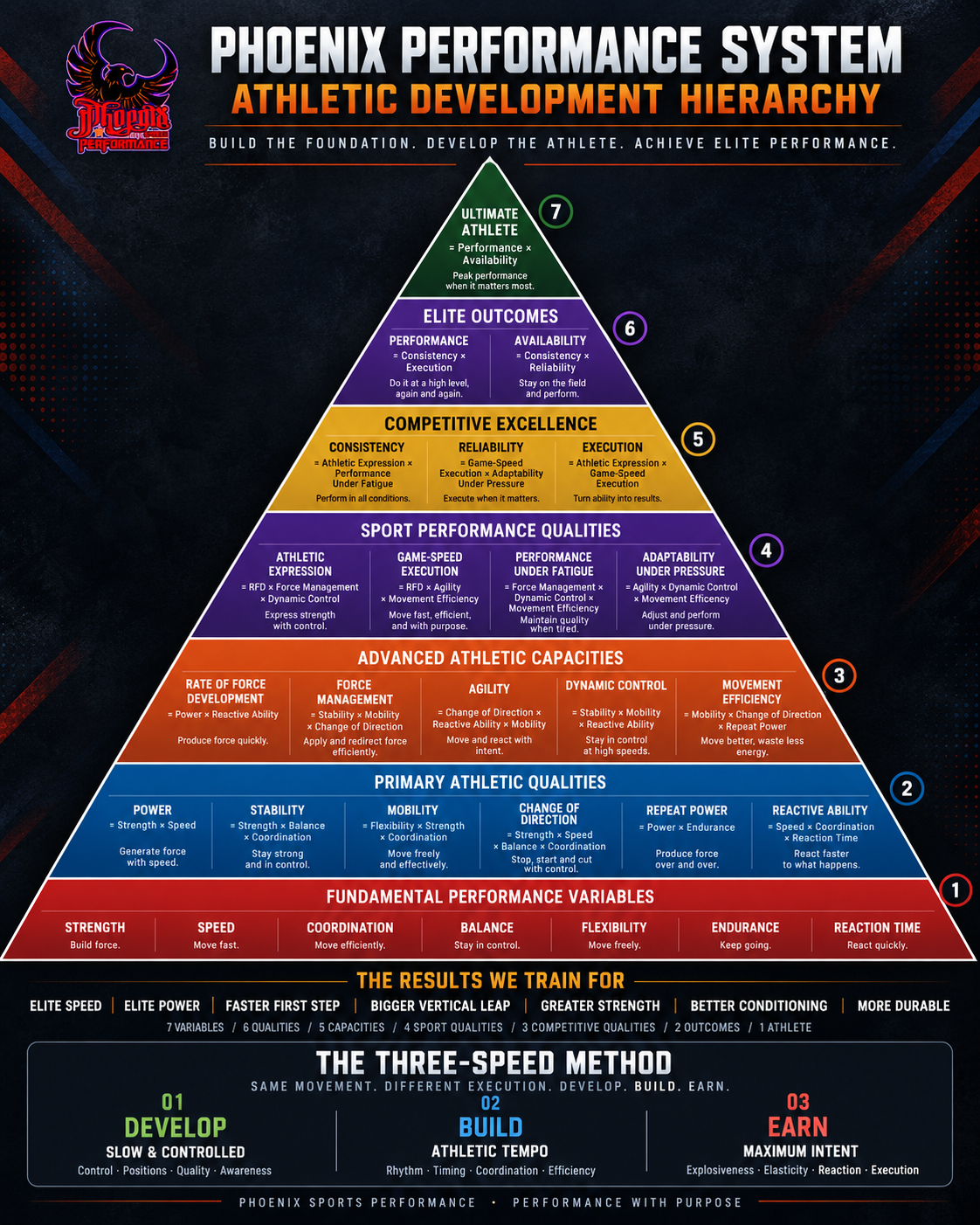
ATHLETIC DEVELOPMENT HIERARCHY.
Seven foundation variables combine into six primary qualities, five advanced capacities, four sport qualities, three competitive qualities, two elite outcomes and one ultimate athlete. Select any level below to read its exact relationships and training purpose.
7FUNDAMENTAL PERFORMANCE VARIABLES
Strength
Produce and control force against resistance.
Speed
Move the body or an object rapidly.
Coordination
Organize and synchronize movement efficiently.
Balance
Maintain body position and equilibrium.
Flexibility
Access available joint and tissue ranges of motion.
Endurance
Sustain physical or metabolic effort over time.
Reaction Time
Respond to a stimulus.
6PRIMARY ATHLETIC QUALITIES
Power
Strength × Speed
Produce high levels of force rapidly.
Stability
Balance × Strength
Maintain position and control under load.
Mobility
Flexibility × Strength × Coordination
Move through available ranges of motion with active control.
Change of Direction
Strength × Speed × Balance × Coordination
Decelerate, redirect and accelerate efficiently.
Repeat Power
Power × Endurance
Repeat explosive efforts while limiting performance decline.
Reactive Ability
Speed × Coordination × Reaction Time
Respond quickly and effectively to changing stimuli.
5ADVANCED ATHLETIC CAPACITIES
Rate of Force Development
Power × Reactive Ability
Generate force as rapidly as possible.
Force Management
Stability × Mobility × Change of Direction
Absorb, control and redirect forces efficiently.
Agility
Change of Direction × Reactive Ability × Mobility
Change direction rapidly in response to a stimulus.
Dynamic Control
Stability × Mobility × Reactive Ability
Maintain body control during fast, reactive movements.
Movement Efficiency
Mobility × Change of Direction × Repeat Power
Execute athletic movements effectively with less wasted effort.
4SPORT PERFORMANCE QUALITIES
Athletic Expression
Rate of Force Development × Force Management × Dynamic Control
Express physical abilities with speed, power and control.
Game-Speed Execution
Rate of Force Development × Agility × Movement Efficiency
Execute athletic movements and skills at competitive speeds.
Performance Under Fatigue
Force Management × Dynamic Control × Movement Efficiency
Maintain movement quality and performance as fatigue accumulates.
Adaptability Under Pressure
Agility × Dynamic Control × Movement Efficiency
Adjust movement and maintain control as competitive demands change.
3COMPETITIVE EXCELLENCE
Consistency
Athletic Expression × Performance Under Fatigue
Repeatedly deliver high-level performance over time.
Reliability
Game-Speed Execution × Adaptability Under Pressure
Execute effectively when circumstances become unpredictable.
Execution
Athletic Expression × Game-Speed Execution
Apply developed athletic abilities during competition.
2ELITE OUTCOMES
Performance
Consistency × Execution
Produce elite athletic results when they matter most.
Availability
Consistency × Reliability
Remain prepared, durable and available to compete consistently.
1ULTIMATE ATHLETE
Ultimate Athlete
Performance × Availability
A complete, resilient, adaptable athlete who can consistently perform at a high level.
The × relationships in this hierarchy represent the coaching model of how qualities interact. They are not all literal physics equations. For example, instantaneous mechanical power is force multiplied by velocity.
THE THREE-SPEED METHOD.
We change the execution, not necessarily the exercise. Tempo, intent and control progress based on the movement and what the athlete needs that day.
DEVELOP
SLOW & CONTROLLEDControl, positions, quality and awareness. Establish strong positions and intentional movement.
BUILD
ATHLETIC TEMPORhythm, timing, coordination and efficiency. Move naturally and effectively at an athletic pace.
EARN
MAXIMUM INTENTExplosiveness, elasticity, reaction and competitive execution. Express speed or force with intent while retaining appropriate control.
HOW IT IS APPLIED
Depending on the athlete and the day, the method may apply to strength exercises, sprints, jumps, agility work, isometrics or conditioning. The variable that changes is specific to the movement - not every exercise should use all three stages.
EXAMPLE WORKING-SET PATTERNS
- 4 working sets: 2 Develop, 1 Build, 1 Earn
- 5 working sets: 2 Develop, 2 Build, 1 Earn
These are programming options, not a mandatory prescription. Readiness, training goals, load and sport demands determine execution.
Strength. Speed. Power. Braking. Change of direction. Conditioning. Movement quality. The result is an athlete who can deliver when it matters.
BOOK PERFORMANCE TRAINING ↗